Repeated reproduction
In warm waters, females can spawn about every four days. Early maturity helps populations build quickly.
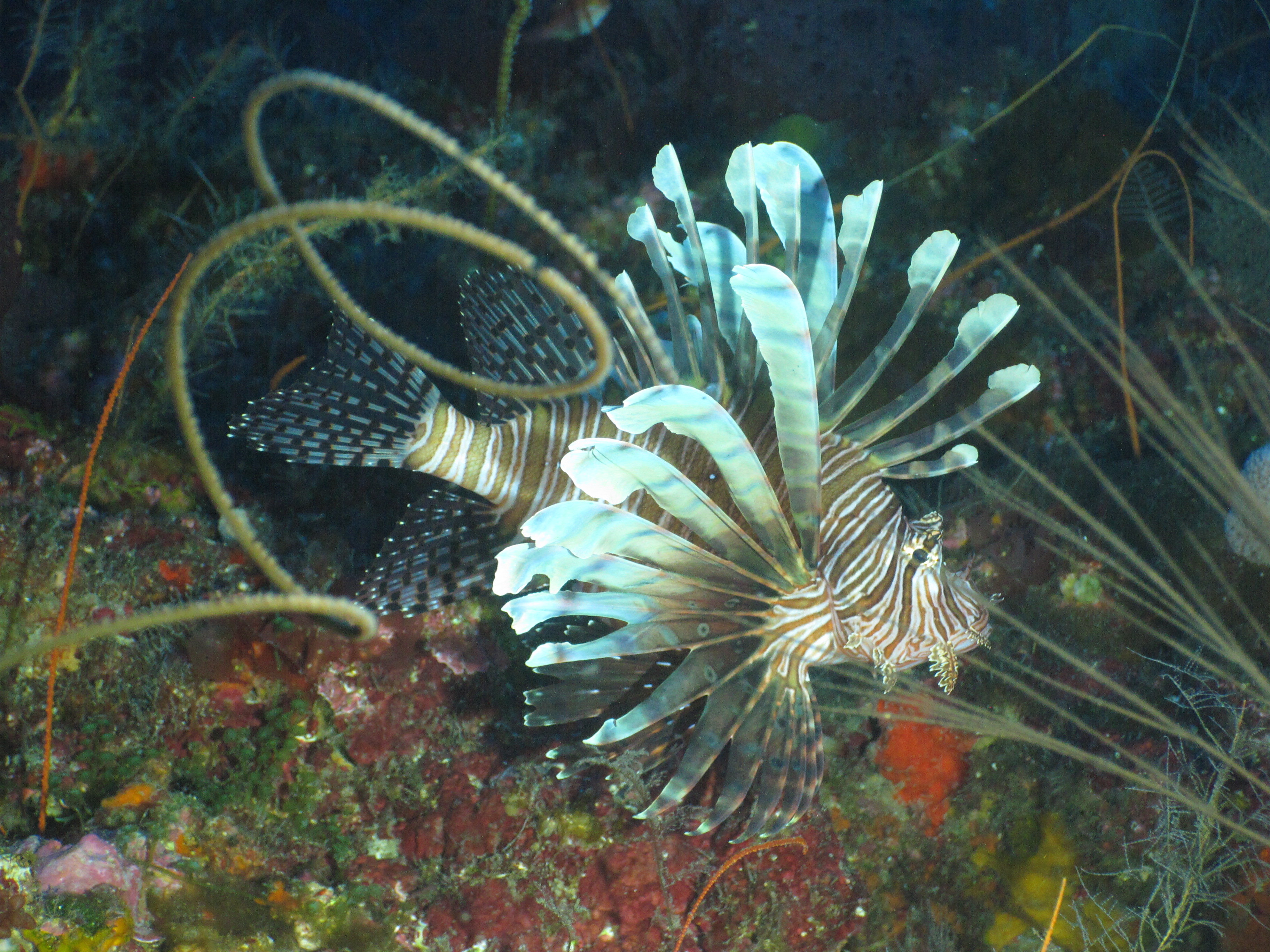
ONE SPECIES. AN OCEAN OF CONSEQUENCES.
Far from their native waters, lionfish are changing the Atlantic. Follow the invasion—and discover where a meal might make a difference.
Explore the restaurant map ↗Dive into the story ↓01 / FROM REEF TO TABLE
18 listings across Florida and the Caribbean, including historical reports, cook-your-catch options and suggested leads. Select a numbered marker or restaurant below.
Sources reviewed September 24–25, 2026; no phone confirmations. Locations are approximate—use the street address for travel. This curated map is not an exhaustive directory. Map tiles require an internet connection; listing details remain available below.
02 / A FISH FAR FROM HOME
Lionfish belong to the Indo-Pacific, including the Indian Ocean and Red Sea. The Atlantic invasion involves two closely related species: Pterois volitans and Pterois miles.
The most likely pathway was the aquarium trade: fish released or escaping into coastal waters. The exact introductions are uncertain. A lionfish was recorded near Dania, Florida, in 1985—years before Hurricane Andrew in 1992. That storm alone cannot explain the invasion.
Explore NOAA’s invasion history ↗In warm waters, females can spawn about every four days. Early maturity helps populations build quickly.
Floating eggs and larvae can travel with ocean currents, linking reefs and carrying the invasion beyond the original release sites.
Venomous spines discourage predators. Lionfish eat many kinds of prey and occupy reefs, wrecks and other habitats.
Biology: Florida Fish and Wildlife Conservation Commission · Dispersal: Texas Parks & Wildlife
03 / FOLLOW THE SPREAD
Choose a year to follow key milestones. A first observation is a record of detection, not necessarily the date of arrival.
Mint: earlier milestones · Orange: selected period. Points represent approximate regional locations, not abundance, exact invasion boundaries or travel routes.
Selected milestones, not a complete occurrence history. Sources: USGS species profile and NOAA.
04 / EVERYTHING IS CONNECTED
Tap a species or group to explore the ripple effects. Arrows point from food to the animal that eats it.
Orange arrows: lionfish feeding · Gray arrows: native feeding
Dashed line: competition for space, not feeding. A simplified web, not a population model.
Prey examples: USGS. Reef effects: NOAA Fisheries. Interactions vary with species, fish size and location.
05 / A SMALL PART OF THE SOLUTION
Yes—when it supports sustained removal from invaded waters.
Find a reported restaurant ↗Restaurant demand can give fishers a buyer for their catch and help cover the time and expense of removal. Repeated, targeted culling can reduce local lionfish numbers and help native fish recover.
Divers cannot reach every reef or deep-water refuge. Lionfish reproduce and recolonize, so effort must continue. Supply can be irregular and expensive; sales alone do not prove a conservation benefit.
The goal is fewer invasive fish on vulnerable reefs—not a permanent supply that depends on keeping them there. Removal complements habitat protection and monitoring; it cannot solve warming, coral disease or pollution.
Choose responsible suppliers who follow local seafood advice. Lionfish have venomous spines; safe handling needs training. Like other reef fish, they can carry ciguatera toxins in some areas, and cooking does not remove those toxins.
Read REEF’s removal work and FWC’s lionfish guidance.
06 / HOW WE KNOW
Field experiments, long-term surveys and sighting records tell different parts of the story. Here is what they can—and cannot—show.
01 · CONTROLLED FIELD EXPERIMENT
Albins & Hixon (2008) found an average 79% reduction in native fish recruitment over five weeks on small Bahamian patch reefs with a lionfish. Recruitment means the addition of young fish. This is not a claim that every reef loses 79% of all fish.
Read the study ↗02 · REEF SURVEYS
Green and colleagues (2012) recorded a 65% decline in the biomass of 42 prey fish species over two years at nine Bahamian reefs, alongside rising lionfish abundance. This regional observation is not a universal forecast.
Read the open-access study ↗03 · REMOVAL EXPERIMENT
Green and colleagues (2014) tested site-specific removal targets. Suppressing lionfish below harmful densities allowed prey fish to recover; complete removal was not always necessary. Maintaining control is different from eradicating the invasion.
Read the study ↗04 · ECOLOGICAL INTERPRETATION
Lionfish eat fish that graze algae. Losing grazers can increase pressure on corals through algal competition. The strength of this chain varies by reef; lionfish do not need to eat coral to affect reef health.
Read NOAA’s explanation ↗05 · OCCURRENCE RECORDS
USGS brings together records of lionfish detections. Uneven reporting and survey effort mean an empty part of a map does not necessarily mean lionfish are absent.
Explore USGS records ↗06 · RESTAURANT EVIDENCE
Each map listing links to its evidence and records our web review date. We distinguish current online menus, historical reports, cook-your-catch options and unverified suggestions. Restaurants were not contacted, and online menus can become outdated.
Review the restaurant sources ↑